How the Internet of Things Is Changing Industries
Introduction
The Internet of Things (IoT) has become one of the most influential technological developments affecting businesses, governments, and consumers worldwide. By connecting physical devices to the internet, IoT enables the collection, exchange, and analysis of data in real time. This connectivity allows organizations to improve operations, increase efficiency, reduce costs, and create new business opportunities.
The rapid growth of connected devices has transformed industries such as manufacturing, healthcare, transportation, agriculture, retail, energy, and logistics. Sensors, smart devices, industrial equipment, and automated systems now communicate continuously, generating large amounts of data that support decision-making and operational improvements.
As digital transformation continues across industries, the Internet of Things remains a major driver of innovation and technological change.
What Is the Internet of Things?
The Internet of Things refers to a network of physical devices connected to the internet that collect, share, and process data. These devices contain sensors, software, processors, and communication technologies that allow them to interact with each other and with centralized systems.
Examples of IoT devices include:
- Smart sensors
- Industrial machines
- Medical equipment
- Smart home devices
- Connected vehicles
- Wearable devices
- Agricultural monitoring systems
- Environmental sensors
The primary purpose of IoT is to improve efficiency, automation, monitoring, and decision-making through data collection and connectivity.
How the Internet of Things Works
The Internet of Things operates through several interconnected components.
Data Collection
Sensors collect information from physical environments.
Examples include:
- Temperature
- Pressure
- Motion
- Location
- Humidity
- Energy consumption
Data Transmission
Collected information is transmitted through communication networks.
Common technologies include:
- Wi-Fi
- Cellular networks
- Bluetooth
- Satellite communication
- Wireless sensors
Data Processing
Cloud platforms and local computing systems process collected data.
Data Analysis
Analytical systems identify patterns, trends, and operational insights.
Action and Automation
Systems respond automatically or provide recommendations to users.
This process creates continuous monitoring and operational optimization.
Key Components of IoT Systems
Several components support Internet of Things operations.
Devices and Sensors
Physical devices collect environmental and operational information.
Connectivity Networks
Communication systems transfer data between devices.
Cloud Computing
Cloud platforms store and process large volumes of data.
Data Analytics
Analytical tools generate business insights.
User Interfaces
Applications and dashboards allow users to monitor and control systems.
These components work together to create complete IoT ecosystems.
Why Industries Are Adopting IoT
Organizations adopt IoT technologies for several reasons.
Operational Efficiency
IoT improves productivity through automation and monitoring.
Cost Reduction
Organizations reduce operational expenses through optimization.
Real-Time Data Access
Decision-makers receive immediate access to operational information.
Improved Customer Services
Businesses provide better customer experiences through connected systems.
Predictive Maintenance
Organizations detect problems before failures occur.
Competitive Advantage
IoT technologies create opportunities for innovation and business growth.
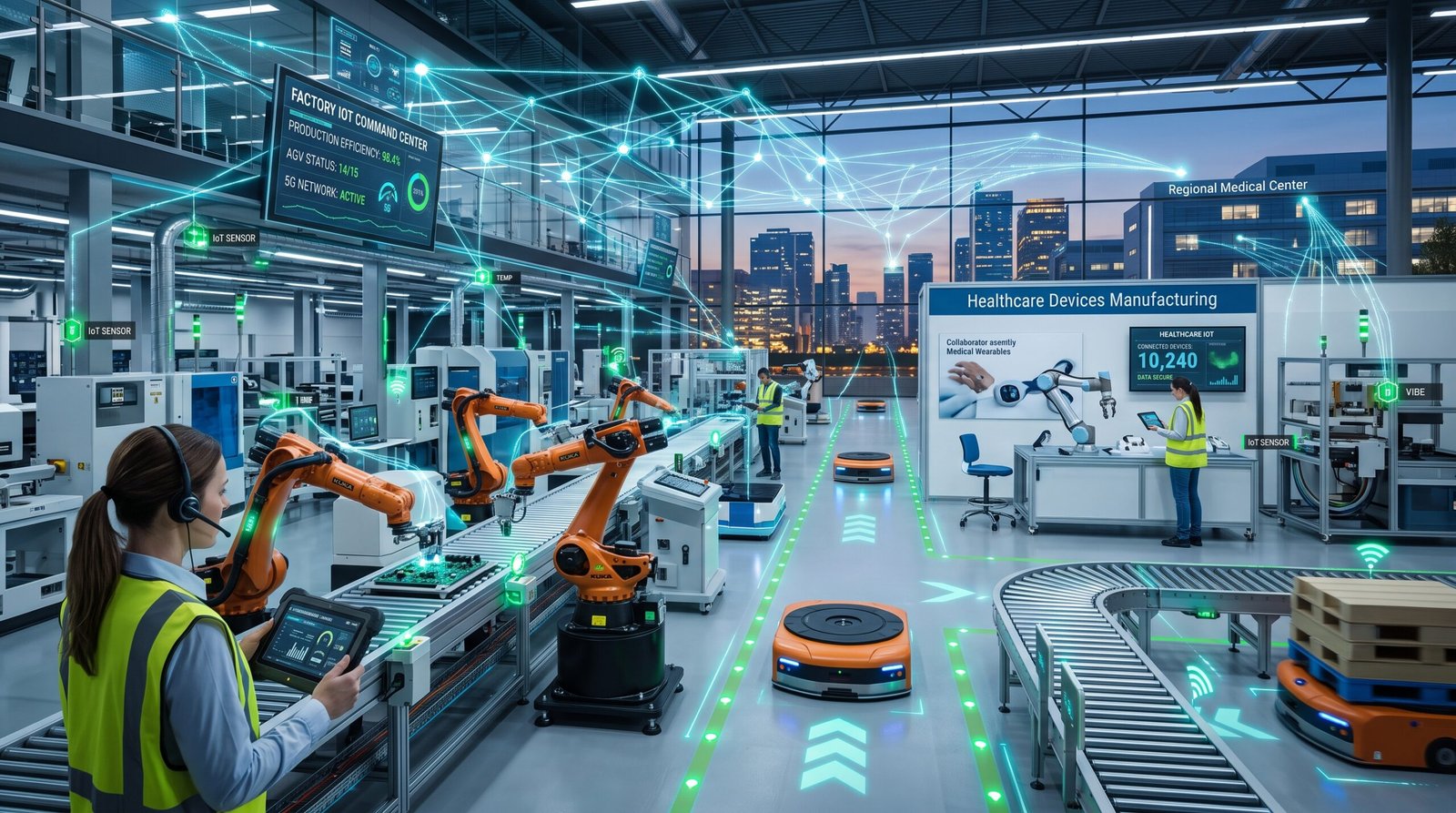
IoT in Manufacturing
Manufacturing remains one of the largest areas of IoT adoption.
Smart Factories
Connected equipment enables automated production systems.
Benefits include:
- Increased productivity
- Reduced downtime
- Improved quality control
- Better resource management
Predictive Maintenance
Sensors monitor equipment performance and identify maintenance requirements.
Benefits include:
- Reduced repair costs
- Less downtime
- Improved equipment lifespan
Production Monitoring
Manufacturers track:
- Output levels
- Machine performance
- Inventory movement
- Production efficiency
IoT supports continuous manufacturing optimization.
IoT in Healthcare
Healthcare organizations increasingly adopt connected technologies.
Patient Monitoring
Connected devices monitor patient conditions continuously.
Examples include:
- Heart monitors
- Blood pressure devices
- Glucose monitors
- Wearable sensors
Remote Healthcare
IoT supports telemedicine and remote patient management.
Benefits include:
- Increased accessibility
- Reduced hospital visits
- Improved patient monitoring
Medical Equipment Management
Hospitals monitor equipment status and usage.
Advantages include:
- Better asset utilization
- Improved maintenance planning
- Reduced operational costs
IoT in Transportation
Transportation industries use IoT technologies extensively.
Connected Vehicles
Vehicles exchange information regarding:
- Location
- Traffic conditions
- Fuel consumption
- Maintenance requirements
Fleet Management
Organizations monitor:
- Vehicle performance
- Driver behavior
- Route efficiency
- Delivery schedules
Traffic Management
Cities use IoT systems to improve:
- Traffic flow
- Road safety
- Transportation efficiency
These applications support smarter transportation systems.
IoT in Agriculture
Agriculture has experienced significant technological changes through IoT adoption.
Precision Farming
Sensors monitor:
- Soil conditions
- Weather patterns
- Water levels
- Crop health
Irrigation Management
IoT systems optimize water usage.
Benefits include:
- Reduced waste
- Improved crop management
- Lower operating costs
Livestock Monitoring
Farmers monitor:
- Animal health
- Movement
- Feeding patterns
IoT supports increased agricultural productivity.
IoT in Retail
Retail businesses use IoT to improve customer experiences and operational efficiency.
Inventory Management
Connected systems track inventory in real time.
Benefits include:
- Reduced shortages
- Improved stock control
- Better forecasting
Customer Experience
Retailers use IoT technologies for:
- Personalized services
- Automated checkout systems
- Digital marketing
Supply Chain Monitoring
Businesses track products throughout the distribution process.
These capabilities improve operational performance.
IoT in Energy Management
Energy companies use IoT technologies to improve efficiency.
Smart Grids
Connected electrical systems monitor energy distribution.
Benefits include:
- Improved reliability
- Reduced outages
- Better resource allocation
Smart Meters
Consumers and providers monitor energy consumption.
Advantages include:
- Increased transparency
- Improved billing accuracy
- Better energy management
Equipment Monitoring
Energy companies monitor infrastructure performance continuously.
IoT in Logistics and Supply Chains
Supply chain operations rely increasingly on connected technologies.
Applications include:
- Shipment tracking
- Warehouse management
- Inventory monitoring
- Route optimization
- Asset management
Benefits include:
- Improved visibility
- Reduced delays
- Increased efficiency
- Better customer service
IoT helps organizations manage complex supply networks.
IoT in Smart Cities
Governments use IoT technologies to improve urban management.
Applications include:
Traffic Control
Connected systems manage transportation networks.
Waste Management
Sensors monitor waste collection requirements.
Public Safety
IoT devices support emergency response systems.
Environmental Monitoring
Cities monitor:
- Air quality
- Water quality
- Weather conditions
- Pollution levels
Smart city technologies improve public services.
IoT in Building Management
Commercial buildings use IoT for operational management.
Applications include:
- Climate control
- Lighting systems
- Security monitoring
- Energy management
- Occupancy tracking
Benefits include:
- Reduced operating costs
- Improved efficiency
- Better resource management
Industrial Internet of Things (IIoT)
The Industrial Internet of Things focuses on industrial applications.
IIoT systems support:
- Manufacturing
- Energy production
- Mining
- Transportation
- Utilities
Benefits include:
- Process automation
- Equipment monitoring
- Data analytics
- Operational optimization
Industrial IoT continues to expand globally.
Benefits of IoT Across Industries
Organizations experience multiple benefits from IoT adoption.
Increased Efficiency
Automation reduces manual processes.
Improved Decision-Making
Real-time data supports informed decisions.
Reduced Costs
Resource optimization lowers expenses.
Enhanced Productivity
Connected systems improve operational performance.
Better Customer Experiences
Organizations deliver improved services.
Increased Innovation
IoT creates opportunities for new products and business models.
Challenges of IoT Adoption
Despite its advantages, IoT presents several challenges.
Security Risks
Connected devices may become targets for cyberattacks.
Privacy Concerns
Large amounts of personal and business data require protection.
Infrastructure Requirements
IoT systems require communication networks and computing resources.
Integration Challenges
Organizations must integrate new systems with existing infrastructure.
Data Management
IoT generates substantial amounts of information.
Maintenance Requirements
Devices require ongoing monitoring and support.
IoT and Artificial Intelligence
Artificial intelligence and IoT increasingly work together.
Applications include:
- Predictive analytics
- Automated decision-making
- Machine learning
- Pattern recognition
- Process optimization
The combination of AI and IoT creates intelligent systems capable of autonomous operations.
IoT and Cloud Computing
Cloud computing supports IoT by providing:
- Data storage
- Processing capabilities
- Analytics tools
- Device management
- System scalability
Cloud platforms enable organizations to manage large IoT ecosystems efficiently.
Future Trends in IoT
Several trends continue shaping IoT development.
Artificial Intelligence Integration
AI capabilities continue expanding.
Edge Computing
Data processing moves closer to connected devices.
5G Networks
Improved connectivity supports larger IoT deployments.
Smart Cities Expansion
Urban IoT applications continue growing.
Industrial Automation
Industries adopt increased automation technologies.
Autonomous Systems
Self-operating systems become more common.
These developments will influence future industry operations.
The Economic Impact of IoT
The Internet of Things contributes to economic growth through:
- Increased productivity
- Technology investment
- New business models
- Employment opportunities
- Operational efficiency
As adoption increases, IoT will continue influencing global economic activity.
Conclusion
The Internet of Things has transformed industries by connecting physical devices, generating data, and enabling intelligent decision-making. Organizations across manufacturing, healthcare, transportation, agriculture, retail, energy, and logistics use IoT technologies to improve operations, reduce costs, and increase efficiency.
Although challenges related to security, privacy, infrastructure, and data management remain, IoT adoption continues to expand worldwide. Combined with technologies such as artificial intelligence, cloud computing, and advanced communications networks, the Internet of Things will remain a major driver of industrial transformation and technological innovation.
Understanding how IoT changes industries provides valuable insight into the future of business operations and digital transformation.
Frequently Asked Questions
What is the Internet of Things?
The Internet of Things is a network of connected devices that collect, transmit, and process data through internet-based systems.
Which industries use IoT technology?
Manufacturing, healthcare, transportation, agriculture, retail, logistics, and energy industries use IoT technologies.
How does IoT improve business operations?
IoT improves efficiency, reduces costs, supports automation, and provides real-time information.
What is Industrial Internet of Things?
Industrial IoT refers to the use of connected technologies in industrial environments such as manufacturing and energy production.
Is IoT secure?
IoT systems require strong security measures because connected devices can face cybersecurity risks.
How does IoT work with artificial intelligence?
Artificial intelligence analyzes IoT data to support automation, predictions, and decision-making.
What is the future of IoT?
Future developments include increased automation, artificial intelligence integration, smart cities, and advanced communication networks.